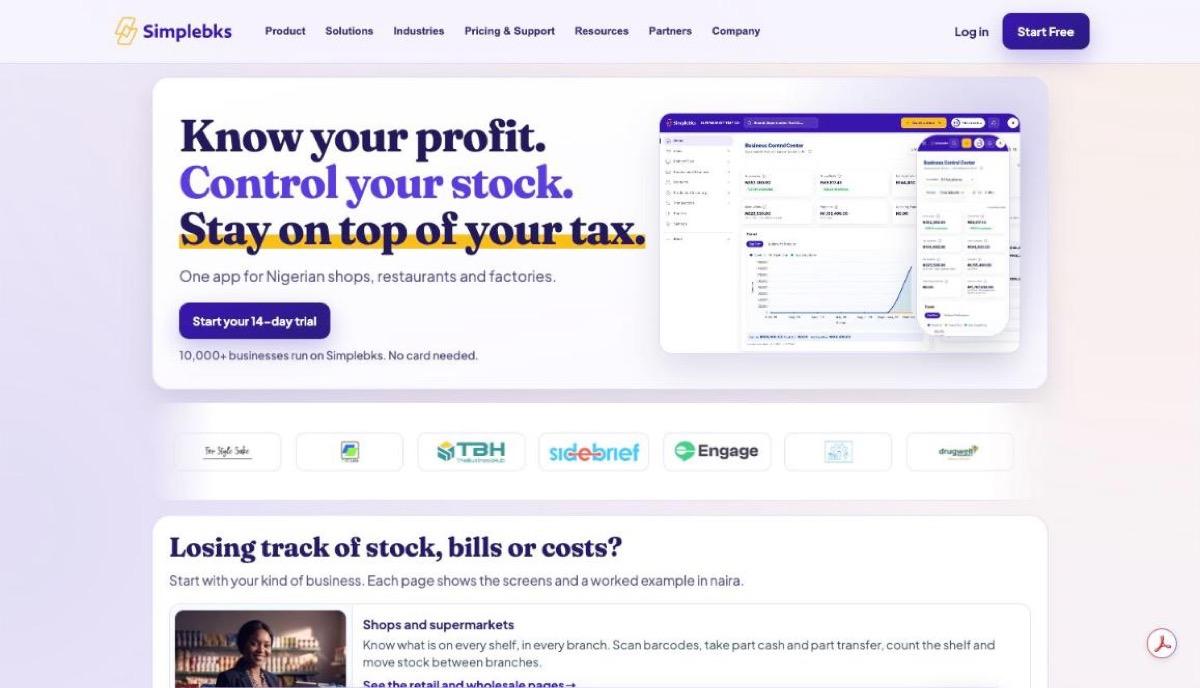
One rule: usable on a busy Tuesday
Every product needs a rule that settles arguments. Ours was simple: if a shop owner can't use a feature on a busy Tuesday without training, the feature is wrong.
That rule shaped everything that followed. It's why the first version focused on the two things an owner does all day, selling and counting stock, and why every new capability has to earn its place on a screen that already has a customer waiting.
If a shop owner can't use it on a busy Tuesday without training, it's wrong.
Starting at the counter
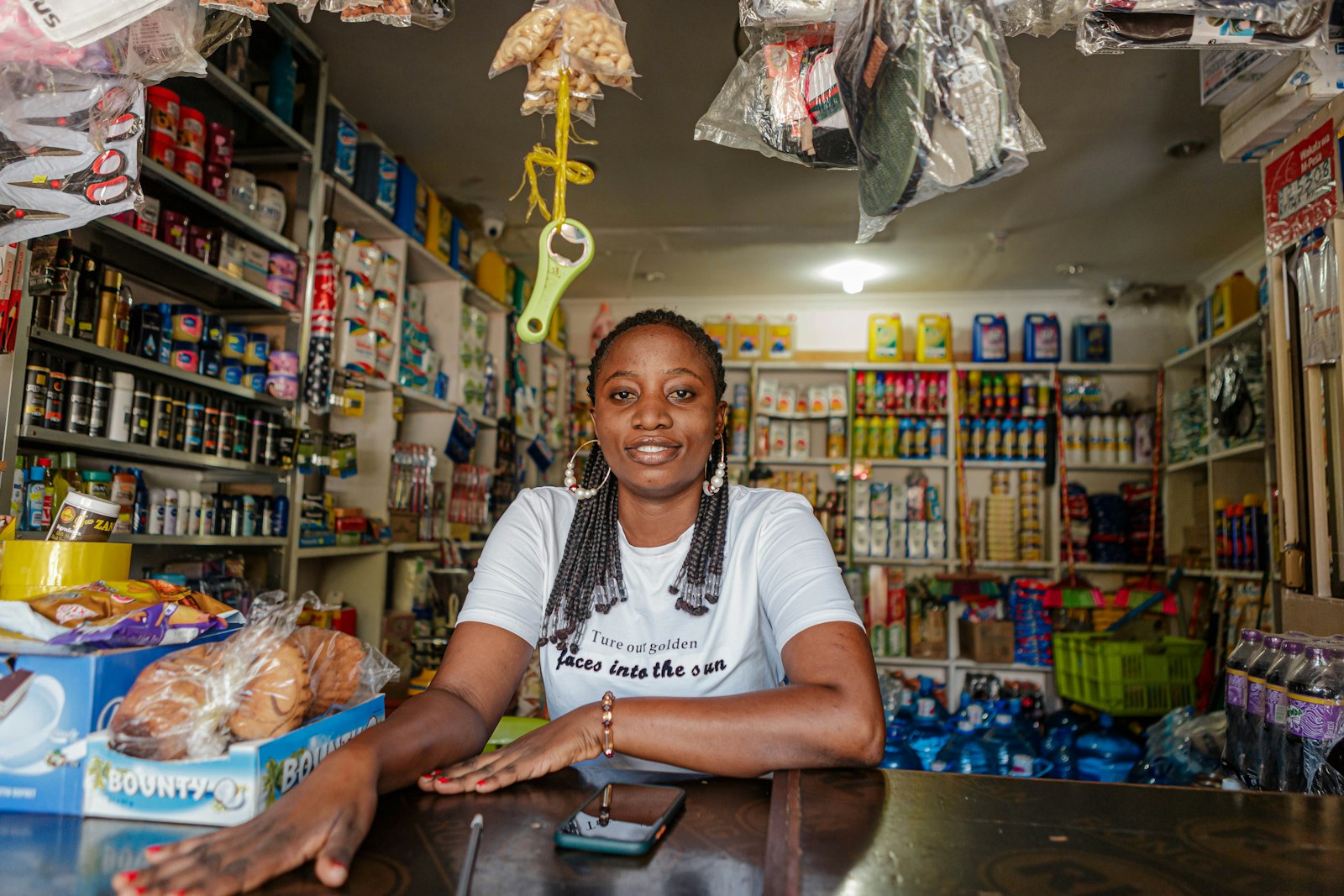
The counter is where money changes hands, so that's where we put the most care. A single sale can be split across cash, transfer and card, because that's how Nigerians really pay. A supervisor's PIN is needed to approve a discount, a refund or a sale on credit, so the owner stays in control without standing at the till. Barcodes make selling fast.
Then we made it dependable. Tills keep selling for up to a day with no internet and sync the moment the connection returns, because a shop in Lagos can't stop trading when the network drops.
Stock you can count on
Stock moves between branches, and every movement is recorded, so 'what's left?' always has an exact answer. Owners can count a shelf, raise a purchase, ask suppliers for quotes, and adjust prices in bulk.
The principle behind it: every carton in and every carton out is tracked automatically, so an owner can reorder on time, spot a shortage early, and tell the difference between theft and a bad memory.
Books that write themselves
The biggest step was making the accounting automatic. Every sale, purchase and expense posts to real books the moment it happens: a chart of accounts, journals, a trial balance and bank reconciliation. Profit and loss, balance sheet, cash flow and ageing reports come out of the same records, as do VAT and withholding tax.
Because the books are real, an accountant can be invited into a client's account, with set permissions and an end date, and work from the owner's own records. For the owner it means the numbers an accountant would ask for are already there.
Every sale posts to the books automatically, so the owner never has to ask what happened.
Growing with the customers
We let customers' needs set the roadmap. Makers needed to know what a batch really costs, so we added recipes, production runs and batch costing against estimates. Restaurants needed to run tables, so we added table service. Businesses that take deposits needed pre-orders. Owners with more than one business needed to see profit across all of them, so we added multi-business and multi-branch views. And a mobile app put the whole business in an owner's pocket.
We also built free tools that deliver value in minutes with no account: an invoice generator, a profit and loss generator, a VAT calculator and an inventory health check. They let a business owner see what good looks like before they commit to anything.
Deciding what to build
A growing product needs discipline about what goes in. We run the roadmap as a numbered tracker of batches. A batch has a clear scope, and once it's agreed, only work that has been reviewed and merged ships. Anything new that we find goes to the next batch, not into the current one. 'Done' means the owner has verified it, not that the code is finished.
Pricing follows the same logic. There are four plans, Free, Basic, Professional and Enterprise, and features are gated by plan so that each plan has a clear reason to exist and a customer always knows what they're paying for. Design follows a written constitution, so a screen built today looks and behaves like one built a year ago.
Accuracy by design
Software that handles money has to be right every time, so we built safeguards that don't depend on anyone remembering to check.
The first is the money matrix. Before any change that touches money can be released, more than two thousand scenarios, around four hundred of them end to end, have to pass. If the matrix isn't green, the release doesn't go. The second is a full accounting audit of every path money takes through the product, to the standard a chartered accountant would expect. The third is a set of repair tools that can recalculate history with a clear before-and-after record, so a correction can always be proved.
Nothing is released straight to customers. Every change is built in isolation, tested on a developer's machine, then on a development environment, then on staging, and only then goes to production, with no downtime. Each release carries a sign-off certificate.
Problems are caught by the gate, never by a customer.
How we look after a live product
When a question comes in from a customer, we trace it to its root, fix it everywhere the same thing could happen, and add a permanent scenario so it stays covered. Every fix leaves the product stronger than it found it.
That habit is what lets the product keep growing without the numbers drifting. The more it does, the more that matters.
Where it stands
Today Simplebks has more than 10,000 users running sales, stock, accounts and teams on it, across shops, restaurants and factories, on web and mobile.
The promise hasn't changed since the first version: an owner should always know whether the business made money. What has changed is how much the product does to keep that promise, and how many safeguards stand behind every number.